
The question
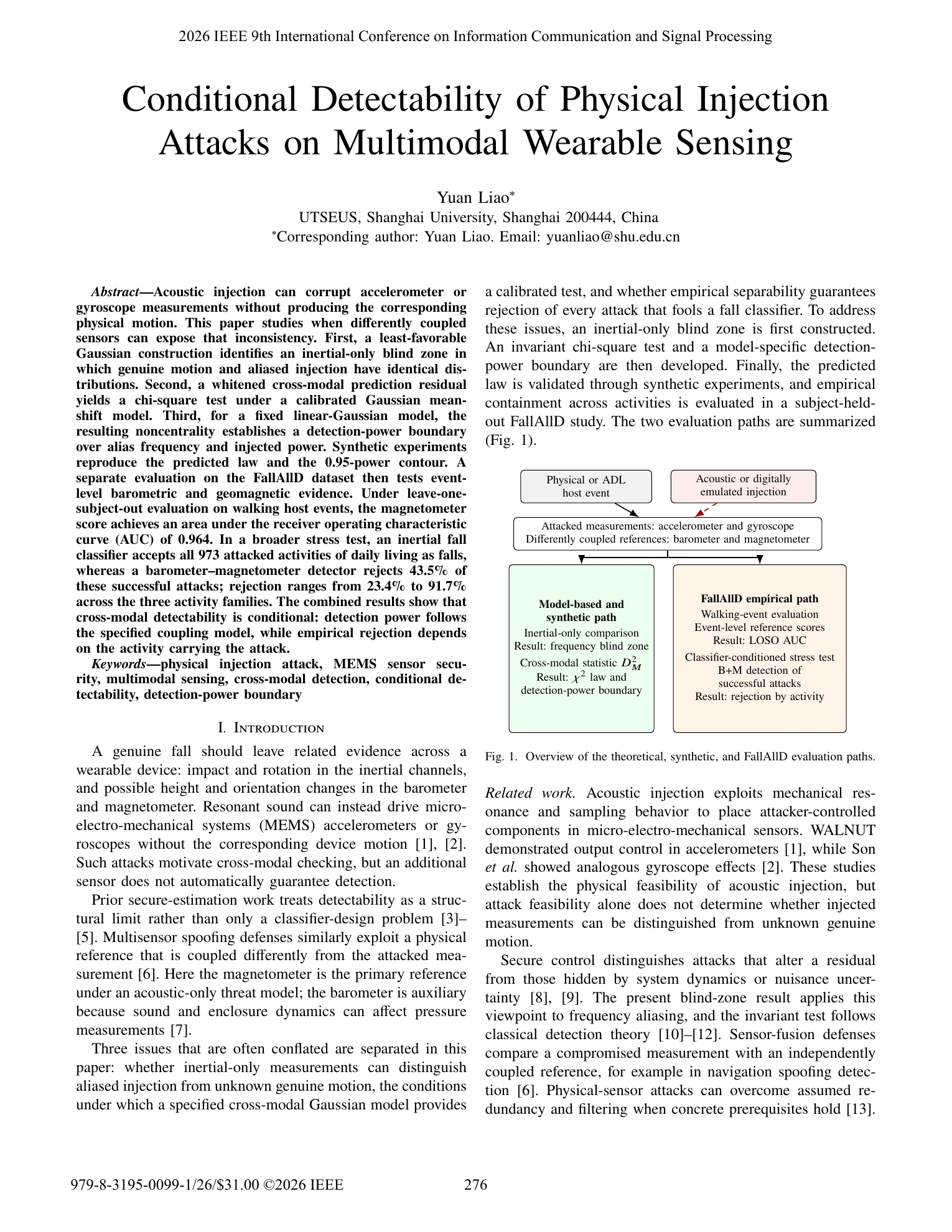
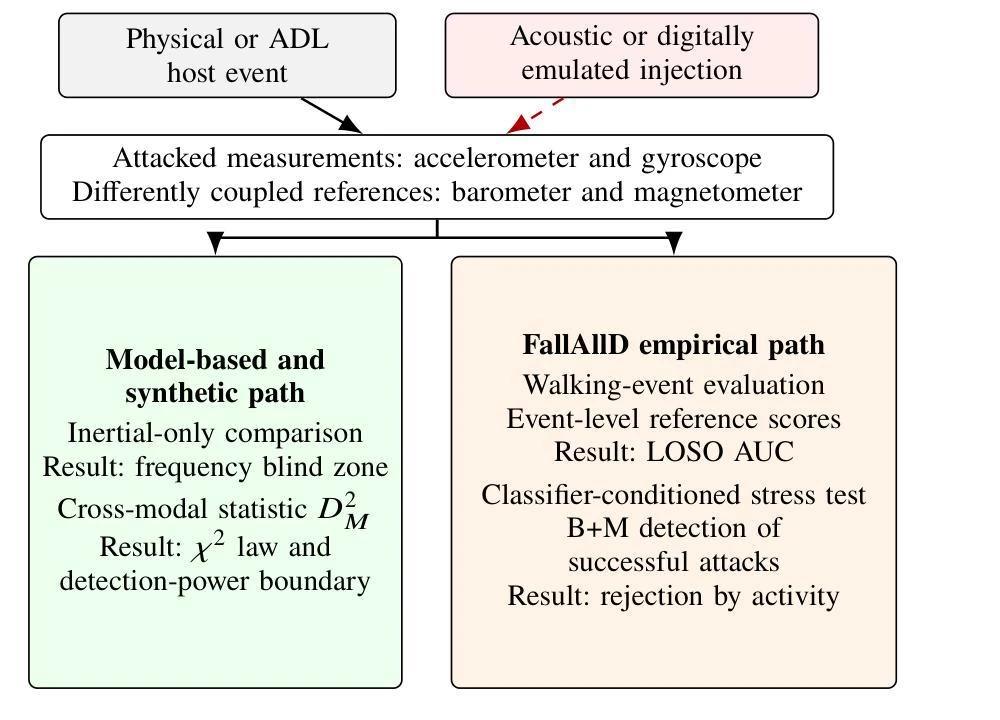
A wearable system can receive signals that look like genuine motion even when a physical injection process has disturbed its inertial sensors. My research asks when an additional sensing modality can expose that inconsistency—and when detection remains limited.
My approach
- Studied an inertial-only blind zone in which forged measurements can imitate genuine-motion distributions.
- Used differently coupled barometer and magnetometer references for cross-modal consistency checking.
- Derived a Mahalanobis-distance statistic, a chi-square decision rule, and a conditional detectability boundary.
Evidence and scope
The portfolio reports evaluation on FallAllD using leave-one-subject-out settings. For forged walking events, the magnetometer-reference detector achieved an AUC of 0.964. This number is specific to that evaluation setting.
Model-based reasoning and digitally emulated injection provide evidence about conditional detection. Physical-hardware validation, broader activity coverage, and generalization remain important directions for further evaluation.
Publication
Conditional Detectability of Physical Injection Attacks on Multimodal Wearable Sensing
Yuan Liao · Sole author · 2026 IEEE 9th ICICSP, Shanghai, September 18–20, 2026. The supplied proceedings contain the paper, and the conference certificate confirms an oral presentation.